
By Nada Hassanein – Tallahassee Democrat, Published 14 July 2018
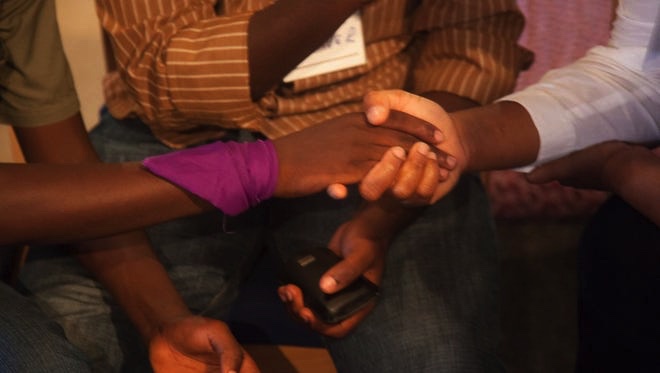
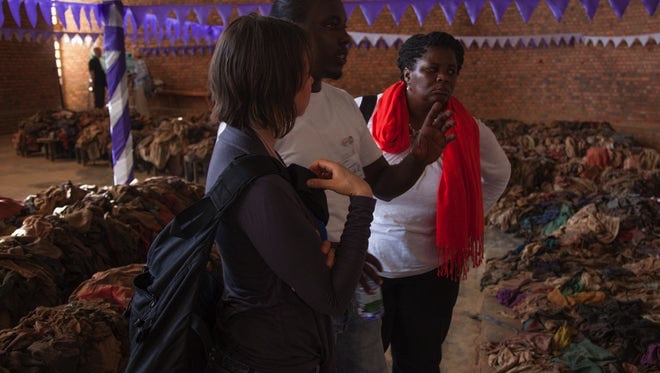
The rooms of the old school turned memorial at Murambi Memorial Centre in Rwanda were filled with the bones of Rwandan Genocide victims. Lorraine Warren walked through the sites, taking in the scenes.
But one room looked different. The bones, preserved with lime, were smaller.
They were the remains of babies.
The Tallahassee woman fell to her knees. Two elderly Rwandan women rushed to help her up. They wiped her tears with sheets from a roll of toilet paper.
“It was almost like the bones were speaking to me,” said Warren, a Tallahassee resident and former Florida State employee. She returned to the Central East African country for her psychology dissertation, “Message in the Bones: Survivor Leaders of Genocide Against the Tutsi, 1994.”
Warren sat pensive under a tree in the Murambi school courtyard. A thought came to her: “What is the message in the bones?”
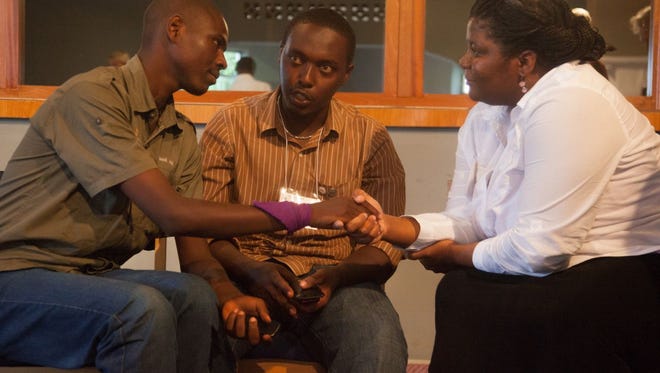
And then a reply — “It’s the little genocides that we commit every day that leads to the big genocides.”
“I have asked myself: What is the work of my hand? Why have I come here? How do I commit little genocides each day through my words, thoughts, or actions?” she wrote in a 2010 essay.
An estimated 800,000 to one million of Rwanda’s Tutsis were killed during the genocide between April and July 1994 at the height of the conflict between the Tutsi and Hutu peoples. July is a month commemorating the end of the killings, with the Fourth of July being Liberation Day, a public holiday in remembrance of the end of the genocide when a ceasefire was declared.
Warren interviewed dozens of survivors, rescuers and perpetrators in the killings for her 2017 dissertation from Pacifica Graduate Institute in Santa Barbara, California, where she received her Ph.D. in depth psychology with a focus on community psychology.
Focusing on survivors, her research delved into “how healing can be facilitated through talking about experiences, service, forgiveness, and education about genocide,” shedding light on “the profound ways in which survivors were impacted by their experience of genocide and how they were led to their calling or work.”
She met people at memorial sites, schools, offices, restaurants. She listened as they pointed vaguely at mass graves, saying their mother or family was buried there. They didn’t know where.
During Warren’s last day in Kigali, the metropolitan capital of Rwanda, a woman begged to tell her story. The survivor, only about 6 or 7 years old during the time of the genocide, told about watching her ill mother get snatched from a roadblock, and raped and murdered before her young terrified eyes.
“I prayed for the courage to tell my story. I prayed that there would be someone who would listen,” Warren recalls her saying. “You are the answer to my prayer.”
“The main message I got,” Warren said, “was the power of listening.”
Along with writing a memoir inspired by her time in Rwanda and other countries, Warren is working on a campaign called Creating a World That Listens. She envisions spaces set up with chairs in schools, parks, malls where people sit and listen to one another.
“I could not solve what happened,” Warren said. “(But) I listened with everything I had… The power of that can change the world.”
Reach Nada Hassanein at nhassanein@tallahassee.com or on Twitter @nhassanein_.
 Lorraine "Dr. Rain" Warren, PhD